1. nima_io: Microscopy Data Reading Tutorial#
This notebook demonstrates reading various microscopy file formats,
comparing nima_io (bioio-based) with tifffile, and inspecting
OME metadata for all available test data.
1.1. Setup#
%load_ext autoreload
%autoreload 2

from pathlib import Path

import matplotlib.pyplot as plt
import tifffile

import nima_io.read as ir

tdata = Path("../../tests/data")
1.2. 1. Single-scene OME-TIFF#
A simple multi-channel time-series OME-TIFF with known structure: 5 timepoints, 3 channels, 17x13 pixels.
# nima_io: returns xarray.DataArray backed by dask
da = ir.read_image(str(tdata / "im1s1z3c5t_a.ome.tif"))
print(f"dims={da.dims}, shape={da.shape}, dtype={da.dtype}")
da.data
dims=('T', 'C', 'Z', 'Y', 'X'), shape=(5, 3, 1, 17, 13), dtype=uint16
|
||||||||||||||||
# Access OME metadata from attrs
da.attrs["ome_metadata"].images[0].pixels.channels
[Channel(
    id='Channel:0:0',
    light_source_settings={'id': 'LightSource:b3870238-479a-45b4-8627-ddb41680e7be_1', 'attenuation': 0.9, 'wavelength': 482.0},
    detector_settings={'id': 'Detector:ec659ce6-9847-4cab-b64a-43b5e9d88f63', 'gain': 5.0, 'binning': <Binning.ONEBYONE: '1x1'>},
    light_path={'excitation_filters': [{'id': 'Filter:cb860710-71c0-46ee-8903-f20019f4b54e'}, {'id': 'Filter:cc5646d0-d3e9-42b6-a147-ad2bda838adf'}, {'id': 'Filter:058c011a-165c-4b82-9cf1-62af018e70d1'}]},
    samples_per_pixel=1,
    illumination_type='Epifluorescence',
    acquisition_mode='WideField',
 ),
 Channel(
    id='Channel:0:1',
    light_source_settings={'id': 'LightSource:b3870238-479a-45b4-8627-ddb41680e7be_2', 'attenuation': 0.9, 'wavelength': 563.0},
    detector_settings={'id': 'Detector:ec659ce6-9847-4cab-b64a-43b5e9d88f63', 'gain': 5.0, 'binning': <Binning.ONEBYONE: '1x1'>},
    light_path={'excitation_filters': [{'id': 'Filter:cb860710-71c0-46ee-8903-f20019f4b54e'}, {'id': 'Filter:cc5646d0-d3e9-42b6-a147-ad2bda838adf'}, {'id': 'Filter:058c011a-165c-4b82-9cf1-62af018e70d1'}]},
    samples_per_pixel=1,
    illumination_type='Epifluorescence',
    acquisition_mode='WideField',
 ),
 Channel(
    id='Channel:0:2',
    light_source_settings={'id': 'LightSource:b3870238-479a-45b4-8627-ddb41680e7be_4', 'attenuation': 0.9, 'wavelength': 458.0},
    detector_settings={'id': 'Detector:ec659ce6-9847-4cab-b64a-43b5e9d88f63', 'gain': 5.0, 'binning': <Binning.ONEBYONE: '1x1'>},
    light_path={'excitation_filters': [{'id': 'Filter:cb860710-71c0-46ee-8903-f20019f4b54e'}, {'id': 'Filter:cc5646d0-d3e9-42b6-a147-ad2bda838adf'}, {'id': 'Filter:058c011a-165c-4b82-9cf1-62af018e70d1'}]},
    samples_per_pixel=1,
    illumination_type='Epifluorescence',
    acquisition_mode='WideField',
 )]
# Structured metadata (consolidated from OME)
md = da.attrs["metadata"]
print(md)
print()
print(f"Objective: {md.objective[0]}")
print(f"Pixel size: {md.voxel_size[0]}")
print(f"Date: {md.date[0]}")
print()
for ci, ch in enumerate(md.channels[0]):
    print(
        f"Ch[{ci}]: wavelength={ch.wavelength}nm, "
        f"attenuation={ch.attenuation}, "
        f"exposure={ch.exposure}s, "
        f"gain={ch.gain}, "
        f"binning={ch.binning}"
    )
Metadata(S=1, T=[5], C=[3], Z=[1], Y=[17], X=[13]
  bits=[16], obj=['Objective:60XWater:f3efd78d-8646-4017-b655-b9b63e83d037']
  voxel_size=[VoxelSize(x=0.1364024, y=0.1364024, z=1000.0)]
  channels=
[[Channel(λ=482, att=0.9, exp=0.045, gain=5.0, binning=1x1),
  Channel(λ=563, att=0.9, exp=0.125, gain=5.0, binning=1x1),
  Channel(λ=458, att=0.9, exp=0.25, gain=5.0, binning=1x1)]])

Objective: Objective:60XWater:f3efd78d-8646-4017-b655-b9b63e83d037
Pixel size: VoxelSize(x=0.1364024, y=0.1364024, z=1000.0)
Date: 2016-09-01 10:49:21

Ch[0]: wavelength=482nm, attenuation=0.9, exposure=0.045s, gain=5.0, binning=1x1
Ch[1]: wavelength=563nm, attenuation=0.9, exposure=0.125s, gain=5.0, binning=1x1
Ch[2]: wavelength=458nm, attenuation=0.9, exposure=0.25s, gain=5.0, binning=1x1
# tifffile comparison
with tifffile.TiffFile(tdata / "im1s1z3c5t_a.ome.tif") as tif:
    print(f"Series: {len(tif.series)}")
    s = tif.series[0]
    print(f"shape={s.shape}, axes={s.axes}, dtype={s.dtype}")
    print(f"OME: {tif.is_ome}")
Series: 1
shape=(5, 3, 17, 13), axes=TCYX, dtype=uint16
OME: True
1.2.1. OME Metadata#
Access the full OME metadata object via bioio.
from bioio import BioImage

img = BioImage(tdata / "im1s1z3c5t_a.ome.tif")
ome = img.ome_metadata
px = ome.images[0].pixels
print(f"Image: {ome.images[0].name or ome.images[0].id}")
print(
    f"Dims: X={px.size_x}, Y={px.size_y}, C={px.size_c}, T={px.size_t}, Z={px.size_z}"
)
print(f"Pixel sizes: {img.physical_pixel_sizes}")
print("Channels:")
for ci, ch in enumerate(px.channels):
    ls = ch.light_source_settings
    wl = ls.wavelength if ls else None
    print(f"  [{ci}] id={ch.id}, wavelength={wl}")
Image: Image:0
Dims: X=13, Y=17, C=3, T=5, Z=1
Pixel sizes: PhysicalPixelSizes(Z=1000.0, Y=0.1364024, X=0.1364024)
Channels:
  [0] id=Channel:0:0, wavelength=482.0
  [1] id=Channel:0:1, wavelength=563.0
  [2] id=Channel:0:2, wavelength=458.0
1.2.2. Per-channel acquisition settings#
Exposure time and timestamps live in planes (one per T/C/Z
combination). Channel-level settings (wavelength, attenuation,
binning, gain) are on the Channel object. Combine both for
a complete per-channel summary.
# Per-channel acquisition summary
for ci, ch in enumerate(px.channels):
    ls = ch.light_source_settings
    ds = ch.detector_settings
    # Exposure from the first plane of this channel
    plane = next(p for p in px.planes if p.the_c == ci)
    print(
        f"Ch[{ci}]: "
        f"wl={ls.wavelength if ls else None}, "
        f"att={ls.attenuation if ls else None}, "
        f"exposure={plane.exposure_time}, "
        f"binning={ds.binning if ds else None}, "
        f"gain={ds.gain if ds else None}"
    )
Ch[0]: wl=482.0, att=0.9, exposure=0.045, binning=Binning.ONEBYONE, gain=5.0
Ch[1]: wl=563.0, att=0.9, exposure=0.125, binning=Binning.ONEBYONE, gain=5.0
Ch[2]: wl=458.0, att=0.9, exposure=0.25, binning=Binning.ONEBYONE, gain=5.0
1.2.3. Channel naming#
Assign semantic channel names for ratio analysis.
da_named = ir.read_image(
    str(tdata / "im1s1z3c5t_a.ome.tif"),
    channels=["G", "R", "C"],
)
print(f"Channel coords: {list(da_named.coords['C'].values)}")
da_named.sel(C="G", T=0).data
Channel coords: [np.str_('G'), np.str_('R'), np.str_('C')]
|
||||||||||||||||
1.3. 2. Multi-channel time-series OME-TIFF#
A 7-timepoint, 3-channel image without wavelength metadata.
da_mcts = ir.read_image(str(tdata / "multi-channel-time-series.ome.tif"))
print(f"dims={da_mcts.dims}, shape={da_mcts.shape}, dtype={da_mcts.dtype}")

img_mcts = BioImage(tdata / "multi-channel-time-series.ome.tif")
print(f"Channel names: {img_mcts.channel_names}")
print(f"Pixel sizes: {img_mcts.physical_pixel_sizes}")
print(f"Image name: {img_mcts.ome_metadata.images[0].name}")
dims=('T', 'C', 'Z', 'Y', 'X'), shape=(7, 3, 1, 167, 439), dtype=int8
Channel names: [np.str_('Channel:0:0'), np.str_('Channel:0:1'), np.str_('Channel:0:2')]
Pixel sizes: PhysicalPixelSizes(Z=None, Y=None, X=None)
Image name: multi-channel-time-series
1.4. 3. File sequences with tifffile.TiffSequence#
For sets of related TIFF files, tifffile.TiffSequence stacks them.
This is useful when acquisitions split across multiple files.
fp_glob = str(tdata / "im1s1z3c5t_?.ome.tif")

tifs = tifffile.TiffSequence(fp_glob)
d = tifs.asarray()
print(f"Glob matched {len(tifs)} files")
print(f"Stacked shape: {d.shape}")
print("Individual files:")
for f in sorted(tifs):
    print(f"  {Path(f).name}")
Glob matched 2 files
Stacked shape: (2, 5, 3, 17, 13)
Individual files:
  im1s1z3c5t_a.ome.tif
  im1s1z3c5t_b.ome.tif
1.5. 4. Tiled images (FEI multi-scene)#
FEI microscopes save tiled acquisitions as multi-scene OME-TIFFs. Each scene is one tile with stage position metadata.
1.5.1. 4a. Regular tile grid (t4_1.tif)#
# bioio sees each tile as a separate scene
img_tile = BioImage(tdata / "t4_1.tif")
print(f"Scenes: {len(img_tile.scenes)}")
print(f"Per-tile shape: {img_tile.shape}")
print(f"Pixel sizes: {img_tile.physical_pixel_sizes}")

# tifffile comparison
with tifffile.TiffFile(tdata / "t4_1.tif") as tif:
    print(f"\ntifffile series: {len(tif.series)}")
    print(f"Per-series shape: {tif.series[0].shape}, axes={tif.series[0].axes}")
Scenes: 15
Per-tile shape: (3, 4, 1, 256, 512)
Pixel sizes: PhysicalPixelSizes(Z=1000.0, Y=0.1333333, X=0.1333333)

tifffile series: 15
Per-series shape: (3, 4, 256, 512), axes=TCYX
# Stitch into a single DataArray
stitched = ir.stitch_scenes(str(tdata / "t4_1.tif"))
print(f"Stitched: dims={stitched.dims}, shape=T{stitched.sizes['T']}")
print(f"  Y={stitched.sizes['Y']}, X={stitched.sizes['X']}")
stitched.data
Stitched: dims=('T', 'C', 'Z', 'Y', 'X'), shape=T3
  Y=1280, X=1536
|
||||||||||||||||
# Tilemap shows scene layout (row, col) -> scene_index
import numpy as np

tilemap = stitched.attrs["tilemap"]
print(f"Tile grid: {tilemap.shape[0]} rows x {tilemap.shape[1]} cols")
print(tilemap)
Tile grid: 5 rows x 3 cols
[[ 0  1  2]
 [ 5  4  3]
 [ 6  7  8]
 [11 10  9]
 [12 13 14]]
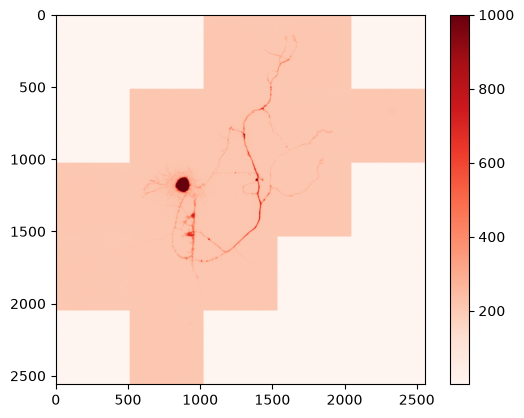
1.5.2. 4b. Tile grid with void tiles (tile6_1.tif)#
stitched_void = ir.stitch_scenes(str(tdata / "tile6_1.tif"))
print(f"Stitched: Y={stitched_void.sizes['Y']}, X={stitched_void.sizes['X']}")

tilemap_void = stitched_void.attrs["tilemap"]
print(f"Tile grid ({tilemap_void.shape}):")
print(tilemap_void)
print(f"Void tiles (=-1): {np.sum(tilemap_void == -1)}")
Stitched: Y=2560, X=2560
Tile grid ((5, 5)):
[[-1 -1  6  4 -1]
 [-1  7  5  3  8]
 [13  2 10  9 -1]
 [12  1 11 -1 -1]
 [-1  0 -1 -1 -1]]
Void tiles (=-1): 11
plt.imshow(stitched_void.sel(T=1, Z=0, C=1), cmap="Reds", vmax=1000, vmin=1)
plt.colorbar()
<matplotlib.colorbar.Colorbar at 0x7f64e7f7f8c0>
1.5.3. Stage positions#
OME metadata provides physical stage positions for each tile.
ome_tile = BioImage(tdata / "tile6_1.tif").ome_metadata
print(f"{'Scene':>5} {'X pos':>10} {'Y pos':>10}")
for i, im in enumerate(ome_tile.images):
    p = im.pixels.planes[0]
    print(f"{i:5d} {float(p.position_x):10.2f} {float(p.position_y):10.2f}")
Scene      X pos      Y pos
    0      50.63      81.84
    1      50.63      81.73
    2      50.63      81.63
    3      50.83      81.53
    4      50.83      81.43
    5      50.73      81.53
    6      50.73      81.43
    7      50.63      81.53
    8      50.93      81.53
    9      50.83      81.63
   10      50.73      81.63
   11      50.73      81.73
   12      50.52      81.73
   13      50.52      81.63
1.6. 5. TF8 format (.tf8)#
TF8 files are TIFFs with a non-standard extension.
nima_io handles this transparently via a temp symlink.
da_tf8 = ir.read_image(str(tdata / "LC26GFP_1.tf8"))
print(f"dims={da_tf8.dims}, shape={da_tf8.shape}, dtype={da_tf8.dtype}")
cjdk: Installing JDK zulu-jre:11.0.32 to /home/runner/.cache/cjdk

Download   0% of  40.9 MiB |             | Elapsed Time: 0:00:00 ETA:  --:--:--
Download 16% of 40.9 MiB |## | Elapsed Time: 0:00:00 ETA: 0:00:00
Download 40% of 40.9 MiB |##### | Elapsed Time: 0:00:00 ETA: 0:00:00
Download 64% of 40.9 MiB |######## | Elapsed Time: 0:00:00 ETA: 0:00:00
Download 75% of 40.9 MiB |######### | Elapsed Time: 0:00:00 ETA: 0:00:00
Download 82% of 40.9 MiB |########## | Elapsed Time: 0:00:00 ETA: 0:00:00
Download 88% of 40.9 MiB |########### | Elapsed Time: 0:00:00 ETA: 0:00:00
Download 94% of 40.9 MiB |############ | Elapsed Time: 0:00:00 ETA: 0:00:00
Download 100% of 40.9 MiB |#############| Elapsed Time: 0:00:00 Time: 0:00:00
Extract / |# | 0 Elapsed Time: 0:00:00
Extract - | # | 328 Elapsed Time: 0:00:00
Extract \ | # | 340 Elapsed Time: 0:00:00
Extract | | # | 362 Elapsed Time: 0:00:00
jar tool not found at /home/runner/.cache/cjdk/v0/jdks/0b234db29c3e54d75ad46da722d98150a0cb7cfd/zulu11.90.19-ca-jre11.0.32-linux_x64/bin/jar
/home/runner/work/nima_io/nima_io/.venv/lib/python3.14/site-packages/pydantic/main.py:263: UserWarning: Casting invalid LightSourceID 'Lightsource:6272fd82-9593-4afe-a826-6d427c2e8771' to 'LightSource:0'
  validated_self = self.__pydantic_validator__.validate_python(data, self_instance=self)
dims=('T', 'C', 'Z', 'Y', 'X'), shape=(1, 1, 1, 1200, 1600), dtype=uint16
1.7. 6. Large single-scene image (exp2_2.tif)#
81 timepoints, 2 channels (340nm/380nm ratiometric), 1200x1600 pixels.
img_exp = BioImage(tdata / "exp2_2.tif")
print(f"Shape: {img_exp.shape}")
print(f"Pixel sizes: {img_exp.physical_pixel_sizes}")

ome_exp = img_exp.ome_metadata
px_exp = ome_exp.images[0].pixels
for ci, ch in enumerate(px_exp.channels):
    ls = ch.light_source_settings
    wl = ls.wavelength if ls else None
    print(f"  Ch[{ci}]: wavelength={wl}")

# Instrument metadata
if ome_exp.instruments:
    inst = ome_exp.instruments[0]
    if inst.objectives:
        obj = inst.objectives[0]
        print(f"Objective: NA={obj.lens_na}, mag={obj.nominal_magnification}")
    if inst.detectors:
        print(f"Detector: {inst.detectors[0].model}")
/home/runner/work/nima_io/nima_io/.venv/lib/python3.14/site-packages/pydantic/main.py:263: UserWarning: Casting invalid LightSourceID 'Lightsource:e9ce7657-3552-460a-bc05-f6fc83991d36' to 'LightSource:1'
  validated_self = self.__pydantic_validator__.validate_python(data, self_instance=self)
/home/runner/work/nima_io/nima_io/.venv/lib/python3.14/site-packages/pydantic/main.py:263: UserWarning: Casting invalid LightSourceID 'Lightsource:e9ce7657-3552-460a-bc05-f6fc83991d36' to 'LightSource:2'
  validated_self = self.__pydantic_validator__.validate_python(data, self_instance=self)
/home/runner/work/nima_io/nima_io/.venv/lib/python3.14/site-packages/pydantic/main.py:263: UserWarning: Casting invalid LightSourceID 'Lightsource:e9ce7657-3552-460a-bc05-f6fc83991d36' to 'LightSource:3'
  validated_self = self.__pydantic_validator__.validate_python(data, self_instance=self)
Shape: (81, 2, 1, 1200, 1600)
Pixel sizes: PhysicalPixelSizes(Z=1000.0, Y=0.74, X=0.74)
  Ch[0]: wavelength=380.0
  Ch[1]: wavelength=340.0
Objective: NA=0.3, mag=10.0
Detector: QImaging Retiga 2000DC
# Lazy read - no data loaded until .values or .compute()
da_exp = ir.read_image(str(tdata / "exp2_2.tif"))
print(f"Lazy DataArray: {da_exp.dims}, {da_exp.shape}")
print(f"Dask chunks: {da_exp.data.chunks}")
/home/runner/work/nima_io/nima_io/.venv/lib/python3.14/site-packages/pydantic/main.py:263: UserWarning: Casting invalid LightSourceID 'Lightsource:e9ce7657-3552-460a-bc05-f6fc83991d36' to 'LightSource:4'
  validated_self = self.__pydantic_validator__.validate_python(data, self_instance=self)
/home/runner/work/nima_io/nima_io/.venv/lib/python3.14/site-packages/pydantic/main.py:263: UserWarning: Casting invalid LightSourceID 'Lightsource:e9ce7657-3552-460a-bc05-f6fc83991d36' to 'LightSource:5'
  validated_self = self.__pydantic_validator__.validate_python(data, self_instance=self)
/home/runner/work/nima_io/nima_io/.venv/lib/python3.14/site-packages/pydantic/main.py:263: UserWarning: Casting invalid LightSourceID 'Lightsource:e9ce7657-3552-460a-bc05-f6fc83991d36' to 'LightSource:6'
  validated_self = self.__pydantic_validator__.validate_python(data, self_instance=self)
Lazy DataArray: ('T', 'C', 'Z', 'Y', 'X'), (81, 2, 1, 1200, 1600)
Dask chunks: ((1, 1, 1, 1, 1, 1, 1, 1, 1, 1, 1, 1, 1, 1, 1, 1, 1, 1, 1, 1, 1, 1, 1, 1, 1, 1, 1, 1, 1, 1, 1, 1, 1, 1, 1, 1, 1, 1, 1, 1, 1, 1, 1, 1, 1, 1, 1, 1, 1, 1, 1, 1, 1, 1, 1, 1, 1, 1, 1, 1, 1, 1, 1, 1, 1, 1, 1, 1, 1, 1, 1, 1, 1, 1, 1, 1, 1, 1, 1, 1, 1), (1, 1), (1,), (1200,), (1600,))
1.8. 7. Leica LIF files#
Multi-scene confocal Z-stacks read via bioio-lif (pure Python, no Java).
img_lif = BioImage(tdata / "2015Aug28_TransHXB2_50min+DMSO.lif")
print(f"Reader: {type(img_lif.reader).__module__}")
print(f"Scenes ({len(img_lif.scenes)}): {img_lif.scenes}")

for si, scene in enumerate(img_lif.scenes):
    img_lif.set_scene(si)
    print(
        f"  {scene}: shape={img_lif.shape}, "
        f"channels={img_lif.channel_names}, "
        f"voxel_z={img_lif.physical_pixel_sizes.Z}"
    )
Reader: bioio_lif.reader
Scenes (5): ('Series001', 'Series004', 'Series007', 'Series009', 'Series011')
  Series001: shape=(1, 3, 41, 512, 512), channels=[np.str_('Green'), np.str_('Gray'), np.str_('Red')], voxel_z=0.2964
  Series004: shape=(1, 3, 40, 512, 512), channels=[np.str_('Green'), np.str_('Gray'), np.str_('Red')], voxel_z=0.2964
  Series007: shape=(1, 3, 43, 512, 512), channels=[np.str_('Green'), np.str_('Gray'), np.str_('Red')], voxel_z=0.2964
  Series009: shape=(1, 3, 39, 512, 512), channels=[np.str_('Green'), np.str_('Gray'), np.str_('Red')], voxel_z=0.2964
  Series011: shape=(1, 3, 37, 512, 512), channels=[np.str_('Green'), np.str_('Gray'), np.str_('Red')], voxel_z=0.2964
1.9. 8. File comparison (diff)#
Compare two files for pixel-level equality.
a = str(tdata / "im1s1z3c5t_a.ome.tif")
b = str(tdata / "im1s1z3c5t_b.ome.tif")
bpix = str(tdata / "im1s1z3c5t_bpix.ome.tif")

print(f"a vs a (identical):  {ir.diff(a, a)}")
print(f"a vs b (same data):  {ir.diff(a, b)}")
print(f"a vs bpix (1px off): {ir.diff(a, bpix)}")
a vs a (identical): True
a vs b (same data): True
a vs bpix (1px off): False
1.10. 9. Backend comparison: nima_io vs tifffile#
Key differences between reading with nima_io (bioio) and raw tifffile.
# tifffile: raw arrays, manual dimension handling
with tifffile.TiffFile(tdata / "t4_1.tif") as tif:
    # Each series is a tile - tifffile doesn't auto-stitch
    tf_data = tif.series[0].asarray()
    print(f"tifffile single series: shape={tf_data.shape}, axes={tif.series[0].axes}")

# nima_io: auto-stitched, named dims, lazy
nio_data = ir.stitch_scenes(str(tdata / "t4_1.tif"))
print(f"nima_io stitched:     shape={dict(nio_data.sizes)}")
print(f"  lazy (dask):        {type(nio_data.data).__name__}")
tifffile single series: shape=(3, 4, 256, 512), axes=TCYX
nima_io stitched:     shape={'T': 3, 'C': 4, 'Z': 1, 'Y': 1280, 'X': 1536}
  lazy (dask):        Array
# tifffile: reading OME metadata requires manual XML parsing
with tifffile.TiffFile(tdata / "im1s1z3c5t_a.ome.tif") as tif:
    # tifffile exposes raw OME-XML string
    ome_xml = tif.ome_metadata  # raw XML string
    print(f"tifffile OME-XML: {type(ome_xml).__name__}, {len(ome_xml)} chars")

# nima_io/bioio: parsed OME object with typed attributes
img = BioImage(tdata / "im1s1z3c5t_a.ome.tif")
ome = img.ome_metadata  # ome_types.OME object
print(f"bioio OME: {type(ome).__name__}")
print(f"  images: {len(ome.images)}")
print(f"  instruments: {len(ome.instruments)}")
ch0 = ome.images[0].pixels.channels[0]
wl = ch0.light_source_settings.wavelength
print(f"  channels[0].wavelength: {wl}")
tifffile OME-XML: str, 47251 chars
bioio OME: OME
  images: 1
  instruments: 1
  channels[0].wavelength: 482.0